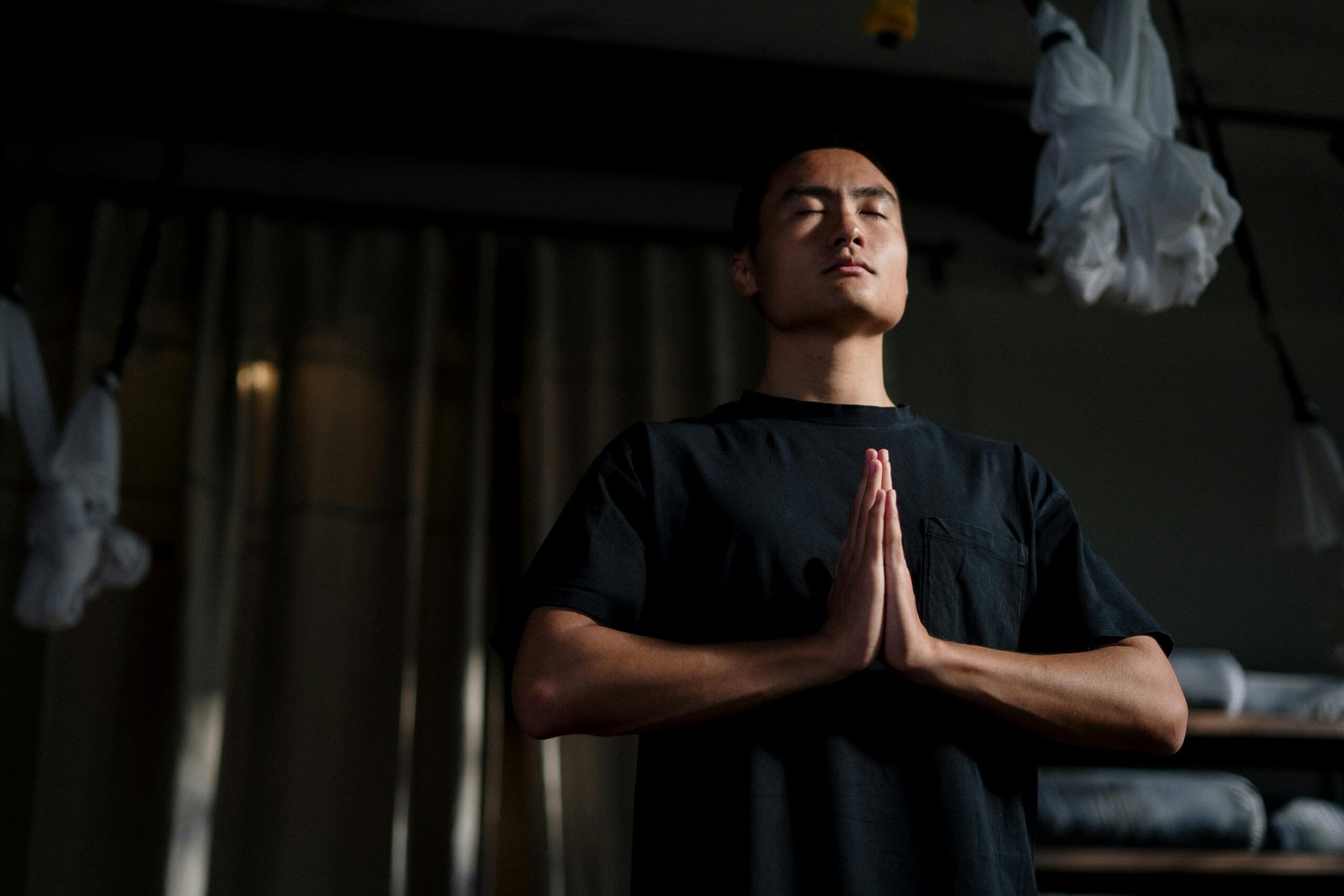
Exploring the science of awareness, intrusive thoughts, and how ancient practices can help cultivate internal calm in an overactive mind.
Introduction: The Exhaustion of the Overactive Min
There is a specific kind of exhaustion that comes not from physical labor, but from the relentless activity of the mind. For many, the mind is not a quiet sanctuary; it is a crowded room where the volume is perpetually turned all the way up. We experience mental overwhelm, anxiety loops, and a profound internal tension that seems impossible to turn off.
When we become trapped in repetitive thoughts, we often over-identify with them. We believe that because a thought has entered our awareness, it must be urgent, true, or dangerous. This over-identification triggers a cascade of physiological responses, locking the body into a state of nervous system hyperactivity. We feel mentally exhausted, constantly seeking certainty in a world that offers none, and feeling profoundly disconnected from our own inner calm.
While ancient traditions have long understood the chaotic nature of the “monkey mind,” modern psychology offers specific frameworks for understanding when this mental activity crosses into clinical territory. For those navigating obsessive-compulsive patterns, the internal noise can feel deafening.
However, emerging research and centuries of contemplative wisdom suggest a powerful synergy. While not a medical cure, practices like mindfulness, meditation, and breath awareness serve as deeply supportive tools. By learning to regulate the nervous system and cultivate mental spaciousness, we can begin to change our relationship with even the most persistent thoughts.
Understanding OCD and Pure OCD
To understand the relationship between OCD and mindfulness, we must first understand the true nature of obsessive-compulsive patterns. Pop culture often misrepresents OCD as a quirk of organization or cleanliness. In reality, it is a complex psychological framework characterized by intrusive thoughts (obsessions) and the repetitive behaviors or mental acts performed to neutralize the distress they cause (compulsions).
One of the most internally agonizing presentations of this is often referred to as Pure OCD (Purely Obsessional OCD). In Pure OCD, the compulsions are largely invisible. The individual experiences terrifying, taboo, or deeply distressing intrusive thoughts, and the compulsions take place entirely within the mind. This involves endless rumination, hypervigilance, mental reviewing, and internal reassurance seeking.
The mind becomes a battlefield. The individual analyzes every thought, trying to prove or disprove its validity, caught in obsessive thought loops that drain their vital energy.
Approaching this requires immense empathy and psychological accuracy. Healing is not about fighting the thoughts or forcing them away—which only reinforces their perceived danger. Instead, it is about shifting how the nervous system reacts to their presence.
The Nervous System and Overthinking
To understand anxiety and overthinking, we have to look beneath the brain and into the body. Chronic stress and nervous system dysregulation act as an amplifier for obsessive thinking.
When an intrusive thought arises, the amygdala—the brain’s threat-detection center—sounds an alarm. The sympathetic nervous system activates, flooding the body with stress hormones like cortisol and adrenaline. You are suddenly thrust into a fight-or-flight response, even though you are sitting safely in your living room.
In this state of hyperarousal, your physiology changes. Your heart rate increases, your muscles tense, and crucially, your breath patterns shift. You begin to take shallow, rapid breaths into the upper chest. This shallow breathing signals back to the brain that you are, in fact, in mortal danger, creating a vicious feedback loop of anxiety and mental fixation.
When the nervous system is dysregulated, the brain’s prefrontal cortex (responsible for logic and perspective) goes offline. You cannot out-think a dysregulated nervous system. This is where the bridge between modern neuroscience and ancient awareness practices becomes vital. Healing the nervous system is often the first step in quieting the mind.
Mindfulness for Intrusive Thoughts
Mindfulness for intrusive thoughts offers a radical paradigm shift. In the depths of anxiety, our instinct is to suppress, fight, or analyze the intrusive thought. Mindfulness teaches us to do the exact opposite: to observe the thought without attachment.
Mindfulness is the practice of paying attention to the present moment, on purpose, and non-judgmentally. For someone experiencing obsessive thinking, developing this awareness creates a crucial pause between stimulus (the thought) and response (the compulsion or panic).
There is a profound difference between suppressing thoughts and observing them. Suppression treats the thought as a threat, which only ensures it will return with greater force. Observation treats the thought as passing weather. Through mindfulness meditation, we learn that we are not the weather; we are the sky.
This practice reduces our reactivity. By creating internal space, we reduce our compulsive identification with mental activity. We learn to say, “I am having a thought about danger,” rather than, “I am in danger.” This subtle linguistic and cognitive shift is the foundation of emotional regulation.
Breathwork and Pranayama: Anchoring the Nervous System
If mindfulness is the practice of observing the mind, breathwork is the practice of anchoring the body. Breathing exercises for OCD and anxiety are not about distraction; they are about physiological intervention.
Pranayama benefits are rooted in the direct connection between the diaphragm and the vagus nerve. Conscious, rhythmic breathing stimulates the parasympathetic nervous system (rest and digest), actively calming physiological stress and promoting emotional release.
Kapalabhati Breathing
Kapalabhati breathing (often called Breath of Fire or Skull Shining Breath) is a rhythmic breathing technique involving forceful exhalations and passive inhalations. While it is highly energizing, its true power lies in mental clarity. By stimulating the system and heavily oxygenating the brain, it creates a cleansing sensation, often sweeping away the brain fog and mental fatigue that accompany chronic rumination. It forces the practitioner into the present moment, acting as a reset button for a looping mind. (Note: This is an activating practice and should be approached gently by those with severe anxiety).
Kumbhaka (Breath Retention)
Kumbhaka breath retention is the practice of holding the breath, either after an inhalation or exhalation. In the pause of the breath, there is often a corresponding pause in the mind. Kumbhaka teaches stillness. It allows the practitioner to experience a moment of profound internal observation and presence. By safely introducing a mild stressor (breath holding) and remaining calm, we train the nervous system to maintain awareness and peace even in moments of internal tension.
Nadi Shodhana and Coherent Breathing
For acute anxiety, slow, diaphragmatic breathing is often the most supportive. Nadi Shodhana (alternate nostril breathing) balances the left and right hemispheres of the brain, bringing the central nervous system into equilibrium. Coherent breathing—breathing at a rate of about five to six breaths per minute—maximizes heart rate variability (HRV) and sends profound signals of safety to the brain.
Meditation and Intrusive Thoughts
There is a pervasive misconception about meditation for OCD and anxiety. Many believe that to meditate successfully, one must “stop” their thoughts. For someone with an overactive mind, this expectation is a recipe for failure and frustration.
Meditation is not the absence of thought. It is the practice of changing your relationship to the thoughts that arise.
When you sit in silence, intrusive thoughts will inevitably surface. The practice is to witness them. By cultivating a state of calm observation, we build emotional regulation and internal spaciousness. We learn that thoughts are simply neurological events—firings of synapses—not absolute truths.
Over time, meditation and intrusive thoughts can coexist. The thoughts may still appear, but they lose their gravitational pull. The reduced reactivity cultivated on the meditation cushion translates directly to daily life, allowing you to experience an obsessive mental loop without being pulled into the vortex of rumination.
Stored Stress and the Mind-Body Connection
We cannot discuss mental overwhelm without addressing its physical toll. Anxiety and emotional tension do not just live in the brain; they take up residence in the body.
Chronic overthinking leads to chronic muscle tension, particularly in the jaw, neck, shoulders, and psoas. It disrupts sleep, impairs digestion, and leads to profound physical fatigue. This is the mind-body connection in action: a mind that feels unsafe creates a body that feels unsafe.
Conscious breathing and mindfulness act as a bridge back to physical safety. By practicing body awareness, we can locate where we are holding our psychological stress. As we use the breath to support relaxation and stress reduction, we facilitate emotional grounding. When the body feels safe, it sends signals upward to the brain, gently lowering the volume of anxious thoughts.
Practical Daily Practices
Integrating these concepts does not require hours of sitting on a cushion. The most effective consciousness practices are those woven into the fabric of daily life. Here are accessible, beginner-friendly tools:
- Breath Awareness: Set a timer for three minutes. Do not try to change your breath; simply observe where it enters and exits the body. This builds the muscle of neutral observation.
- Mindful Walking: Take a walk without a podcast or phone. Focus entirely on the physical sensation of your feet touching the ground. When the mind wanders to an obsession, gently return your focus to the soles of your feet.
- The Mindful Pause: Throughout the day, take one conscious, deep diaphragmatic breath before responding to an email, opening a door, or eating a meal.
- Body Scans: Lie down and mentally scan your body from head to toe, observing sensations without trying to fix them. This grounds you in the physical present, pulling energy away from the mental realm.
- Slow Nasal Breathing: When anxiety peaks, close your mouth and take slow, light, deep breaths through the nose. Focus on making the exhalation longer than the inhalation to trigger the vagus nerve.
The Science of Awareness
The integration of yoga breathing techniques and mindfulness into mental health is heavily supported by modern science. Mindfulness research has consistently shown that consistent practice increases the density of the prefrontal cortex (responsible for executive functioning and logic) and decreases the reactivity of the amygdala (the fear center).
Breathwork for anxiety is grounded in the science of stress reduction. Studies on slow, rhythmic breathing demonstrate significant improvements in autonomic nervous system regulation, lowering blood pressure and cortisol levels. Through neuroplasticity, we know that the brain changes based on how we direct our attention. By repeatedly directing our attention away from rumination and toward the present moment, we physically rewire the brain for greater peace.
Important Disclaimer
It is crucial to approach this topic with deep responsibility. Mindfulness, meditation, and breathwork are profoundly supportive complementary tools, but they are not substitutes for professional mental health support.
OCD and severe anxiety are complex conditions that often require clinical care, including specialized therapies like Exposure and Response Prevention (ERP) and, in some cases, medication. Furthermore, meditation practices can affect people differently. For some, sitting in silence can initially heighten anxiety. It is vital to approach these practices gently, mindfully, and ideally under the guidance of a trauma-informed teacher or in tandem with a licensed therapist.
Conclusion: Returning to Presence
Healing the nervous system and navigating an overactive mind is a journey of deep compassion. It is important to remember that healing is not about eliminating thoughts completely. A mind that produces thoughts is simply doing what it was designed to do.
True inner peace can coexist with mental activity. Through pranayama for mental clarity and mindfulness meditation, we realize that awareness changes our relationship with our thoughts. We learn that we do not have to believe everything we think.
The nervous system, no matter how dysregulated, can learn safety again. The breath is always available to us—a constant, rhythmic anchor back to the present moment. By cultivating internal spaciousness, we step out of the chaotic stream of overthinking and rest on the quiet riverbank of our own awareness, watching the water flow by.