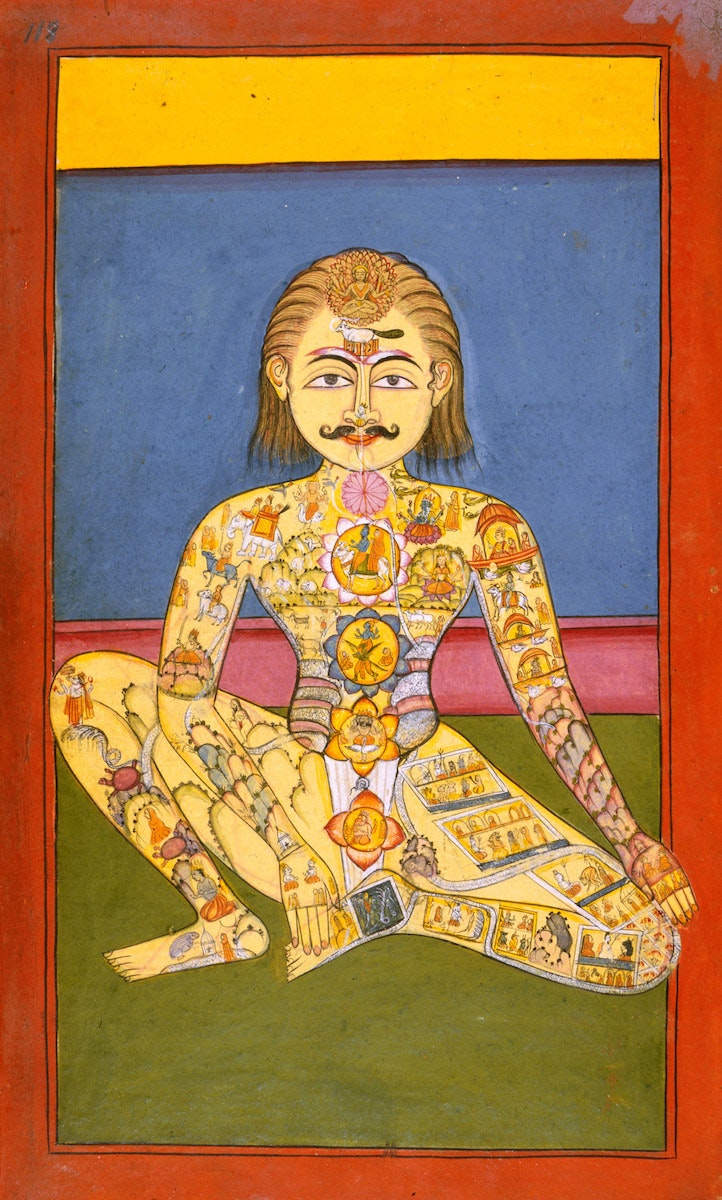
Long before neuroscience mapped the nervous system, yogic seers charted a different kind of anatomy — one made not of tissue and bone, but of energy, consciousness, and light. At the centre of this ancient map are the chakras: seven spinning vortices of life force that run along the spine, each governing a distinct dimension of human experience. Understanding them is not merely a spiritual exercise — it is the foundation of The Pantheon Method and the key to unlocking the full power of breathwork practice.
What are the chakras?
The word chakra comes from Sanskrit, meaning wheel or disk. In the yogic tradition, chakras are subtle energy centers located along the sushumna nadi — the central channel that runs from the base of the spine to the crown of the head. Prana, the life force, flows through this channel and through tens of thousands of subsidiary nadis (energy pathways), animating the body and mind.
The seven main chakras are not metaphors. They are precise locations where consciousness and physiology intersect — where emotional patterns, physical tendencies, and spiritual qualities cluster and express themselves. When energy flows freely through all seven, the human being functions at full capacity: grounded, creative, powerful, loving, expressive, perceptive, and connected to something greater than itself.
The seven energy centers: from earth to cosmos
1. Muladhara — Root Chakra
Location: Base of the spine | Element: Earth
The root chakra is the foundation of the entire energy system. It governs survival, safety, tribal belonging, and the felt sense of being held by the earth. When Muladhara is open and vital, there is a quality of deep steadiness — the capacity to face life without being destabilised. When blocked, fear, scarcity thinking, and physical depletion take hold. In The Pantheon Method, the practice begins here — grounding awareness in the body before moving upward through the centers.
2. Svadhisthana — Sacral Chakra
Location: Below the navel | Element: Water
The sacral center is the seat of creativity, pleasure, and emotional flow. Water is its element — and like water, its energy must move to stay alive. Stagnation here manifests as creative blocks, emotional numbness, or compulsive seeking. Kapalabhati breathing — the sharp, rhythmic exhales at the heart of The Pantheon Method — stimulates this center directly through abdominal activation, loosening held emotion and restoring creative vitality.
3. Manipura — Solar Plexus Chakra
Location: Navel center | Element: Fire
Manipura means city of jewels — and this is where the inner fire lives. It governs will, personal power, discipline, and transformation. In Kriya and Kapalabhati practice, the forceful exhale originates here: the abdominal pump that generates tapas — internal heat — the sacred fire of purification. Ancient yogic texts describe this center as the engine of the entire practice. Modern anatomy maps it to the solar plexus nerve network and the body’s core powerhouse. When Manipura ignites, lethargy burns away and purpose becomes clear.
4. Anahata — Heart Chakra
Location: Centre of the chest | Element: Air
Anahata means unstruck sound — the vibration that exists before any external cause. This is the bridge between the lower three chakras (the personal, instinctual self) and the upper three (the transpersonal). The heart center governs love, compassion, grief, and the capacity to give and receive freely. Breath retention — Kumbhaka — practiced at the heart creates profound stillness here, allowing practitioners to touch the subtle pulse of awareness beneath all activity.
5. Vishuddha — Throat Chakra
Location: Throat | Element: Ether (space)
The throat center is the gateway of expression — where inner truth becomes outer sound. When Vishuddha is open, communication is clear, authentic, and resonant. In breathwork practice, the quality of the exhale, the soundscape that carries the practice, and the vibration of breath through the vocal apparatus all activate this center. The binaural soundscapes used in The Pantheon Method work directly on the vibrational field of this chakra.
6. Ajna — Third Eye Chakra
Location: Between the eyebrows | Element: Light
Ajna is the command center — the seat of intuition, inner vision, and the capacity to see beyond the surface of things. In yogic anatomy, this is where the three main nadis converge. It corresponds in modern neuroscience to the prefrontal cortex and pineal gland. Breath retention and deep interoceptive focus during The Pantheon Method naturally draw awareness here, creating the characteristic clarity and expanded perception that practitioners report after sessions.
7. Sahasrara — Crown Chakra
Location: Crown of the head | Element: Pure consciousness
The thousand-petalled lotus. Sahasrara is the destination — the dissolution point where individual identity opens into universal awareness. The yogic tradition describes its activation as samadhi: a state of such profound stillness that the boundary between self and cosmos becomes transparent. This is the territory The Pantheon Method is designed to approach — not as a destination promised, but as a direction pointed toward, one breath at a time.
Kundalini: the force that moves through the centers
In Tantric and Kriya traditions, dormant at the base of the spine coils Kundalini Shakti — the primordial life force, described as a serpent of pure energy. Yogic practice — particularly sharp, rhythmic breathing like Kapalabhati combined with breath retention and concentrated awareness — is designed to awaken this force and draw it upward through the chakras. Each center it passes through is purified, activated, and integrated. The journey from Muladhara to Sahasrara is the journey from ordinary human experience to the full flowering of consciousness.
This is not mythology dressed in metaphor. The physiological correlates are measurable: increased core temperature, altered brainwave states, heightened interoceptive sensitivity, and shifts in autonomic balance that modern science is only beginning to document. For more on the neuroscience, see Effect of Breathwork on Brain Function and Health and 3 Ways to Change Your Brain.
How The Pantheon Method works with the energy centers
The Pantheon Method is not a generic breathwork class — it is a structured journey through the seven chakras using ancient Kriya techniques as the vehicle. Each 50-minute session moves sequentially through the energy centers, using Kapalabhati, breath retention, guided attention, and binaural soundscapes to activate, clear, and integrate each one in turn.
The sharp, forceful exhales of Kapalabhati generate tapas — the internal heat that purifies. The retentions create stillness and depth. The guided focus on each energy center channels the awakened prana precisely where it needs to go. By the time awareness reaches the crown, practitioners have passed through every layer of their being — physical, emotional, volitional, relational, expressive, perceptual, and transcendent.
This is breathwork as the ancients intended it: not stress relief, not a wellness trend, but a systematic method for purifying the human instrument and awakening it to its full potential. If you are ready to experience the chakras not as a concept but as a lived reality, explore The Pantheon Method.